
|

What is the Total UK Public Spending?
For the year ending in March 2027:
Total UK public spending, including central government and local authorities, is estimated at
£1,383.5 billion.
UK National Spending Analysis
This page shows the current trends in UK national spending. Also see charts on UK spending history.
Recent UK Total Public Spending
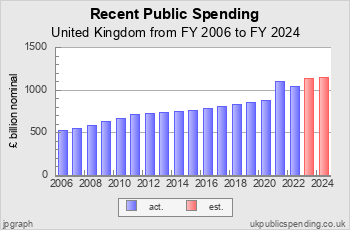
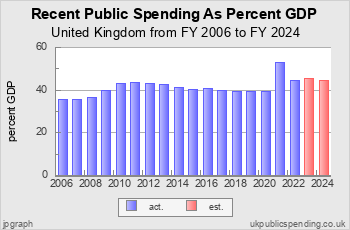

Major UK Public Spending Programs

Chart S.04t: Major Spending Programs
UK public spending in 1990 at the end of the premiership of Margaret Thatcher was 30 percent of GDP. Major spending functions were Pensions at 3.58 percent GDP; Health Care at 3.66 percent GDP; Education at 3.68 percent GDP and Welfare at 5.48 percent GDP.
By 2000 UK public spending was up a little at 31.1 percent of GDP. Major spending functions were Pensions, up sharply at 6.00 percent GDP; Health Care at 4.52 percent GDP; Education at 3.90 percent GDP and Welfare at 5.38 percent GDP.
By 2010 UK public spending was up sharply at 43.1 percent of GDP in the aftermath of the global credit crisis. Major spending functions were Pensions, up to 7.45 percent GDP; Health Care up to 6.94 percent GDP; Education up to 5.67 percent GDP and Welfare at 7.09 percent GDP.
By 2020 UK public spending was down to 39.32 percent of GDP just before COVID. Major spending functions were Pensions, down to 7.15 percent GDP; Health Care up to 7.30 percent GDP; Education down to 4.03 percent GDP and Welfare down to 5.33 percent GDP.
By 2023 after the COVID era UK public spending was up to 45.29 percent of GDP. Major spending functions were Pensions, at 7.10 percent GDP; Health Care up to 8.45 percent GDP; Education at 4.21 percent GDP and Welfare at 5.88 percent GDP.
Spending Data Sources
Expenditure data since 1983 comes from HM Treasury’s Public Expenditure Statistical Analysis reports.
Detailed table of spending data sources here.
Gross Domestic Product data comes from measuringworth.com.
Central government spending data begins in 1692.
Local authority spending data begins in 1868.
Site Search
Data Sources for 2022_2028:
Sources for 2022:
GDP: OBR EFO supp. economy tables
Spending: HM Treasury PESA
Debt: OBR Public Finances Databank
Sources for 2028:
GDP: OBR EFO supp. economy tables
Spending: HM Treasury PESA
Debt: OBR Public Finances Databank
> spending data sources for other years
On July 23, 2026 ukpublicspending.co.uk updated UK GDP and public debt outturn and forecasts released with the Office of Budget Responsibility in March 2026.
Recent and forecast GDP comes from the UK Office of Budget Responsibility's Economic and fiscal outlook report, using table 1.1 from tab "1.1" and table 1.2 from tab "1.2" in a spreadsheet file labeled "March 2026 Economic and fiscal outlook -- detailed forecast tables: economy". UK GDP previous to 2009 comes from Measuring Worth. The data goes back to 1700.
Note that chain-linked GDP is now in 2019 pounds.
Public sector net debt, outturn and forecast, comes from a tab called "Aggregates (£bn)" in the Public Finances Databank spreadsheet at the Office of Budget Responsibility.
Quick Links
Get spending chart.
Download spending table.
Download spending data series.
Review data sources.
Masthead
ukpublicspending.co.uk was designed and executed by:
Christopher Chantrill.
Report bugs here.
Budget News
Budget 2012: 50p tax rate scrapped and allowance raised
Personal allowance now close to £10,000.
Autumn Statement 2011
Chancellor George Osborne introduces six more years of pain.
Budget 2011: George Osborne set for 8bn pound windfall
Treasury revenue up, so no spending cuts in Budget 2011
> archive